
Artificial Grass: Low‑Maintenance Lawns, Putting Greens, and Pet Turf
Designed for Florida and Alabama heat, humidity, and heavy rain, modern synthetic turf gives you an evergreen lawn, a true‑rolling backyard putting green, or a durable pet turf area without constant watering, fertilizing, or reseeding.
Some yards here never even get their moment to shine. You water, you patch, you drag the mower out in 95‑degree heat, and still the same spots stay thin, the same corners turn to mud, and one good storm undoes weeks of effort. Add a couple of dogs, some kids, maybe a pool, and it starts to feel like the lawn has a grudge against you.
That is really the heart of artificial grass on the Gulf Coast. It isn’t a toy or a shortcut for people who don’t care about their property. It is a practical choice to put down a surface under your family, your pets, and your golf habit that can take heat, humidity, heavy rain, and daily use, then wake up the next morning looking ready for company.
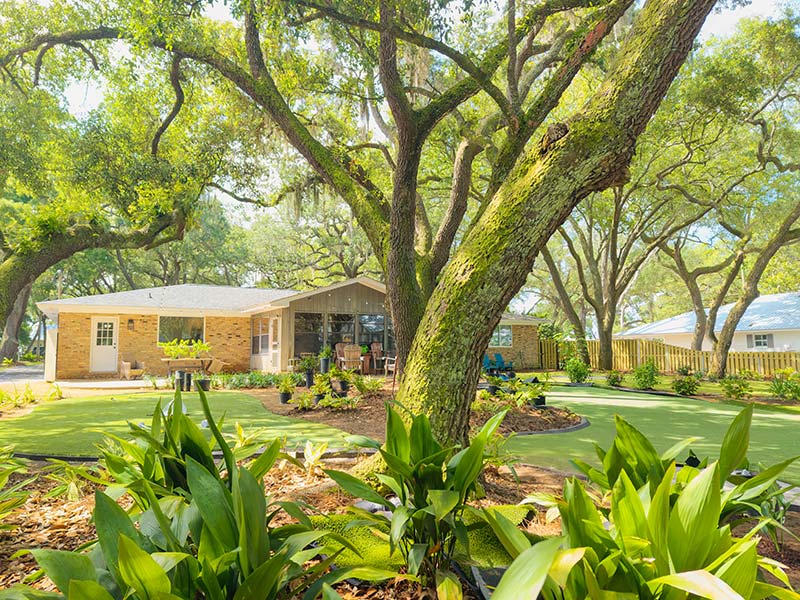
What Modern Artificial Grass Really Is In Plain English
How Today’s Artificial Grass Is Built
Let’s clear something up: we’re not talking about the shiny green carpet from old putt‑putt courses.
Modern turf is more like a little system built layer by layer:
- There’s a backing that holds everything together and gives it strength.
- Fibers that stand up like grass blades and are shaped, textured, and colored so they look and feel closer to the real thing.
- Infill, usually sand or a specialty product, that sits between the fibers and helps them stand up, gives the surface the right firmness, and affects things like ball roll for golf.
- Holes and channels in the backing that let water drop through so it doesn’t just sit on top.
Good turf is made to resist fading in our sun and hold its shape when kids, dogs, and friends put it to work. It’s not indestructible, but it’s a big step up from what most people picture when they hear “fake grass.”
Why Artificial Grass Works Here And Where It Doesn’t
Our weather is a mix of “paradise” and “are you kidding me.” Long hot seasons, soup‑thick humidity, and storms that show up like uninvited guests.
Here’s where artificial grass tends to shine:
- Hard‑used lawns that never recover from kids running, dogs playing, or parking an extra vehicle.
- Areas that stay muddy after every rain or every time the sprinkler runs.
- Shady strips where grass just gives up year after year.
- Pool decks and patio areas where you want a soft, clean surface.
And here’s where we usually hit the brakes a bit:
- Low spots that routinely flood or hold standing water for a long time.
- Big open areas with zero shade where surface temperatures would simply be uncomfortable.
- Yards where you’re trying to support a lot of native planting, pollinators, and wildlife.
Turf is a tool, not a cure‑all. The trick is using it in the right spots and pairing it with the right drainage and landscape choices instead of trying to cover every square inch.
Why Gulf Coast Homeowners Are Switching To Artificial Grass
Always‑Green Curb Appeal And Space You Can Actually Use
There’s a reason those real estate photos always show perfect lawns. A steady, green yard makes everything around it look better.
With artificial grass, you get:
- A lawn that doesn’t bleach out every summer or turn patchy when the seasons change.
- Fewer bare trails along the fence or spots where kids cut the corner again and again.
- A yard that’s not off‑limits for two days after every big storm.
Front yard, back yard, and side yard all start to feel like one connected outdoor room instead of a mix of good patches and problem zones.
Less Work, Less Water, More Free Time
Think about what goes into a natural lawn here: mowing, edging, sharpening blades, buying fuel, setting timers, fixing irrigation, spreading fertilizers, treating weeds. It adds up, both in time and in money.
When you switch to artificial grass, the rhythm changes:
- No weekly mowing or edging.
- No “hope this fertilizer works this time” runs to the store.
- Irrigation often gets scaled way back or removed around turf areas.
You’ll still do some care, just different things: rinsing, brushing, and the occasional deeper clean. But you’re doing it on your time, not racing a growth spurt after a week of rain.
For a lot of people, that’s the real payoff: fewer chores, more evenings on the patio.
The Environmental Conversation You Actually Deserve
Let’s be honest here. Turf has upsides and downsides. You should hear both.
On the upside:
- You can cut water use in those areas, which matters where utilities and infrastructure are already under strain.
- You avoid putting so many fertilizers and weed killers into the ground that later end up in our bays, rivers, and the Gulf.
- You retire at least one noisy mower and everything that comes with it.
On the downside:
- Artificial surfaces can run hotter in full sun than natural grass.
- The materials are synthetic, so there are fair questions around micro‑plastics and long‑term impact.
- A yard that is only turf doesn’t offer the same habitat or cooling effect as a mixed, living landscape.
We like a blended approach. Use turf where you need durability and clean lines. Use trees, shrubs, and groundcovers where you want shade, life, and habitat. That balance tends to feel better all around.
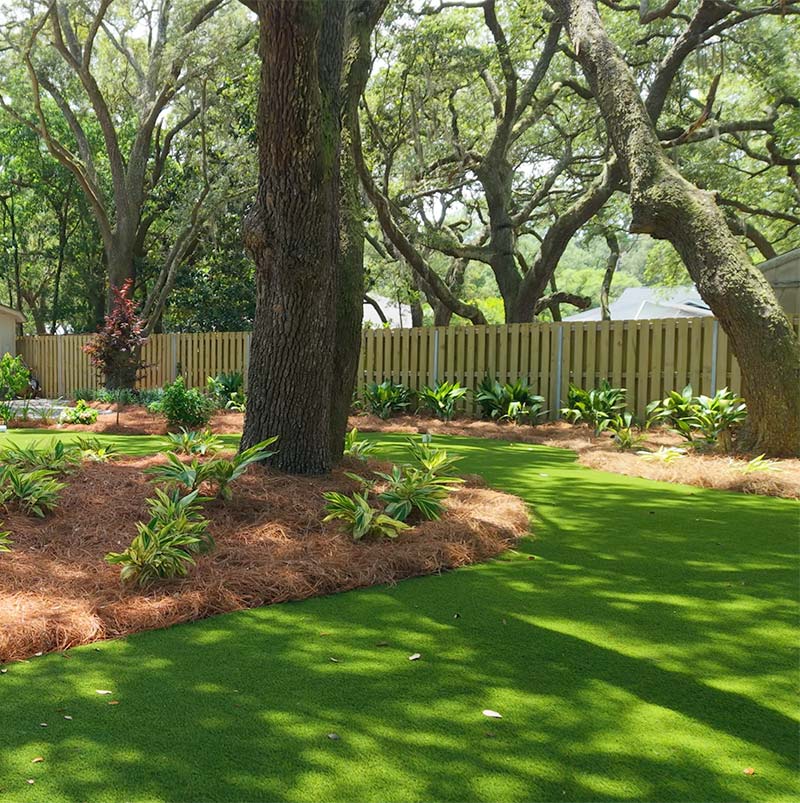
How Artificial Grass Fits Into Your Home Life
Where Turf Makes The Most Sense Around Your Property
Every yard has trouble spots. Some of the usual suspects we see:
- Front lawns that struggle to look consistent no matter what you do.
- Side yards, those long skinny runs that mowers hate and mud loves.
- Kid zones around trampolines or swing sets where grass loses the battle.
- Pool areas where you want less grit in the water and more comfort under bare feet.
- Slopes that erode or never truly green up.
In each of these, turf can turn a constant headache into a “done” space.
Making It Look Like It Belongs In Your Neighborhood
Artificial grass doesn’t have to scream “I’m fake.” The details matter.
We adjust:
- Pile height so it matches your idea of a nice lawn, whether that’s tight and manicured or a bit softer.
- Color blends so you see gentle variation like you would in a healthy natural lawn.
- Edges so turf meets beds, patios, and walkways in a clean, deliberate way.
- Shapes and lines so it fits the style of your house, not just a perfect rectangle dropped in place.
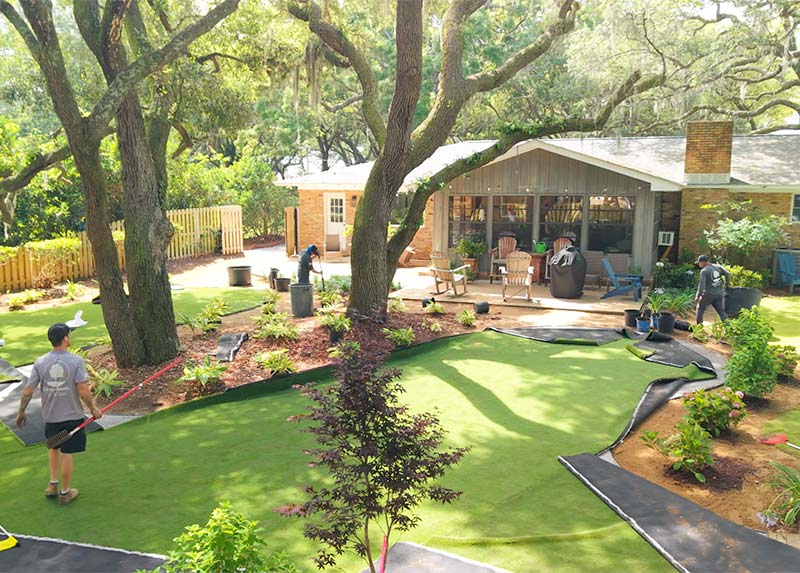
We also keep an eye on the bigger picture. Turf doesn’t have to replace your plants. In a lot of yards, it frames them instead, giving you both order and life in the same space.
What Day‑To‑Day Care Really Looks Like
A realistic maintenance picture looks something like this:
- Blow or sweep off leaves and debris so they don’t mat down the fibers.
- Rinse off dust, pollen, or spills when you notice them.
- Brush high‑traffic areas here and there to perk the blades back up.
- Once in a while, do a more thorough clean, especially in zones that get heavy use.
Compared with mowing, trimming, and constant repair work, it’s a lighter load. That doesn’t mean you abandon the yard. It just means you’re more of a caretaker than a full‑time grounds crew.
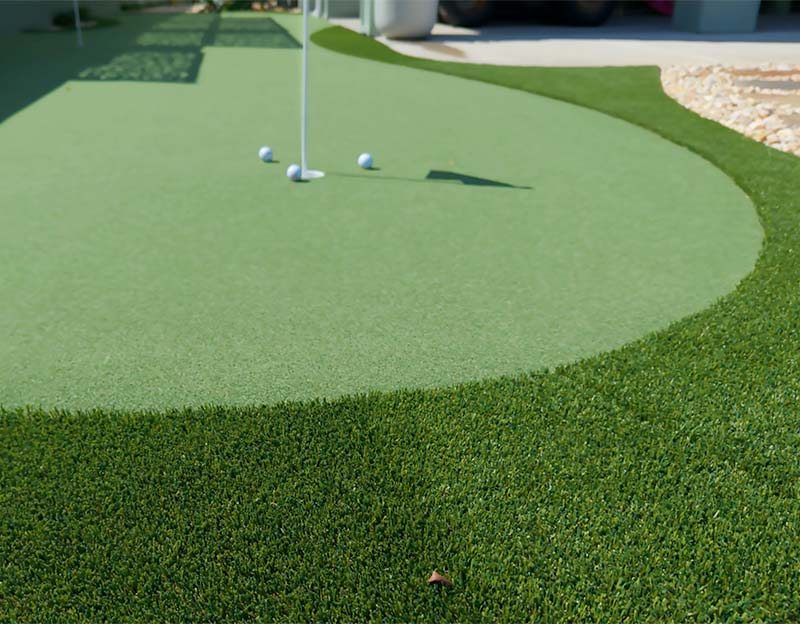
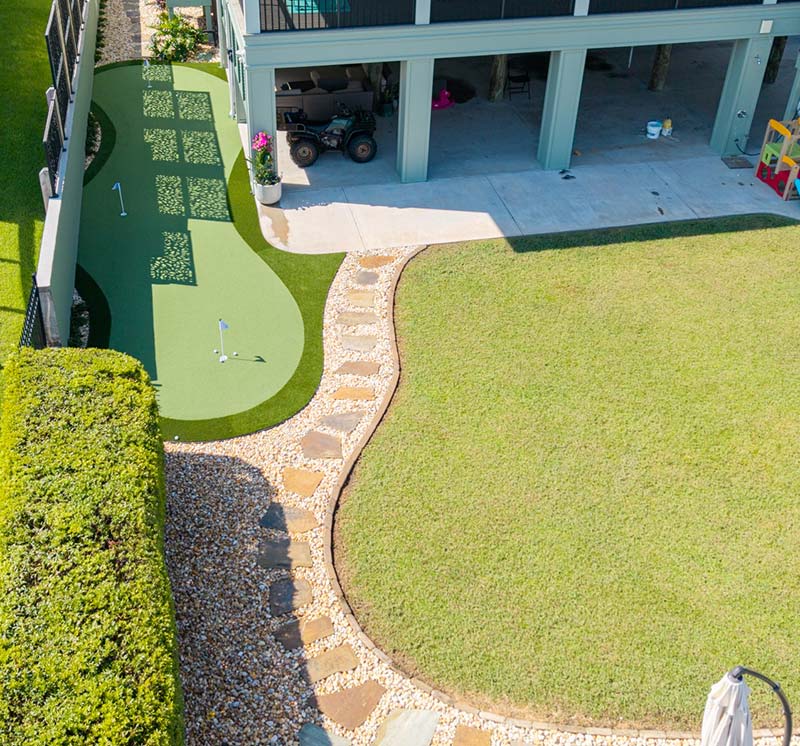
Backyard Putting Greens For Real Practice At Home
Why Golfers Are adding Putting Greens In Their Yards
If you love golf, you know you lose strokes close to the hole, not just from the tee box. The snag is finding time to practice.
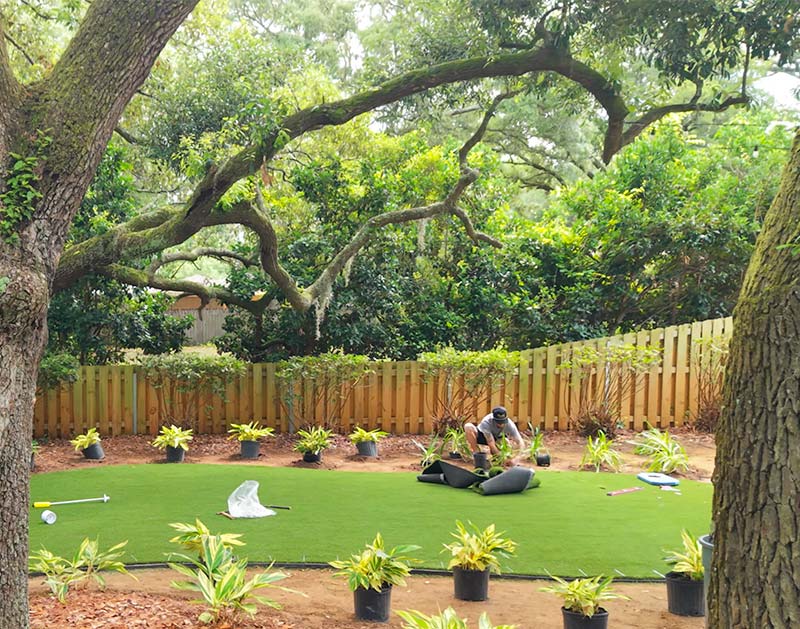
A backyard green solves that quietly. You come home from work, grab a wedge and a putter, and you’re practicing within minutes. No cart fee, no time on the road, no waiting on the foursome ahead of you.
Modern golf turf rolls more consistently than you might expect. When it’s installed correctly, the speed and feel are close enough to real greens that your practice transfers to the course.
How We Think Through Your Green Design
We don’t just roll out a rectangle and call it a day. A good putting green is tuned to you.
We look at:
- How much space you have and how you want to move around it.
- Whether you care more about short putts, longer putts, or chipping.
- How fast you want it to play under normal conditions.
- Where to place cups and what kind of breaks and slopes keep it fun.
- How the green ties into the rest of your yard so it doesn’t look dropped in.
Because of our storms, we take the base very seriously. You want a green that drains, stays true, and doesn’t get wavy or spongy after a long rainy stretch.
Taking Care Of A Synthetic Green
You don’t need a greenskeeper, but a bit of regular attention goes a long way.
Simple habits:
- Keep the surface clear of leaves and branches.
- Brush now and then to keep fibers consistent.
- Pay attention after large storms to make sure everything still feels firm and true.
It’s a small trade for having a place ten steps from your back door where you can work on the part of your game that actually saves strokes.
Pet Turf So Your Dogs And Your Floors Can Both Win
Why Grass And Dogs Fight So Much Here
If you have dogs, you already know this story.
They run the fence line, dig at the corners, pick one or two favorite bathroom spots, and before long your lawn has turned into a patchwork of bare dirt, yellow circles, and mud.
Here, with our rain and humidity, those spots can stay nasty for a long time. Odor hangs around. Mud finds its way onto tile, rugs, and couches. And you start to feel like you’re constantly chasing it.
What Sets Pet Turf Apart
Pet turf is regular turf’s tougher cousin.
It usually has:
- A stronger backing that holds up better to claws and running.
- Fibers selected to resist matting from repeated traffic.
- A base and infill setup meant to drain liquid waste quickly and reduce odor.
- Surfaces that are simple to rinse and keep sanitary.
That combination lets dogs be dogs without turning the rest of your property into a sacrifice zone.
A Realistic Cleaning Routine For Dog Owners
Keeping pet turf fresh is less complicated than rehabbing a torn‑up lawn, but it does take a little routine. You’ll typically:
- Scoop solids promptly, just like you would on natural grass.
- Rinse the main areas on a regular schedule so urine doesn’t linger.
- Use pet‑safe cleaning solutions occasionally to handle odor and bacteria.
- Watch out for “favorite corners” that need more frequent attention.
If you’ve got multiple dogs or a small yard, you’ll rinse more often in the warm months. The trade‑off is that you’re not re‑sodding or patching the same spots over and over.
Straight Answers On Heat, Safety, Drainage, And Cost
How Hot Does Artificial Grass Get And What Can You Do About It
On a bright summer day, lots of surfaces get hot. Turf is no different and can feel warmer under bare feet than natural grass.
That doesn’t mean you have to write it off, but it does mean planning with some common sense. We usually suggest things like:
- Using shade from trees, structures, or even simple umbrellas in key areas.
- Avoiding huge open fields of turf where people will spend long periods in bare feet.
- Mixing turf with cooler materials so you have options.
- Giving the surface a quick rinse on extreme days before kids or pets go out.
We’ll talk through how you actually use your yard and suggest layouts that fit your habits instead of fighting them.
Is It Safe For Kids And Pets
Safety is one of the first questions parents and pet owners ask, and it should be.
We focus on:
- Turf lines that are tested for things like heavy metals.
- Underlay options in play areas to soften falls.
- Clear, practical cleaning habits so surfaces stay hygienic.
At the same time, more research is happening around chemicals and micro‑plastics in synthetic products. We follow that closely and lean toward suppliers who take testing and transparency seriously.
If you have health concerns, allergies, or specific questions, we’d rather talk through them in detail than brush them off with a simple “it’s fine.”
How Drainage Works During Gulf Coast Storms
The secret to a yard that doesn’t turn into a swamp isn’t the turf itself. It’s what’s under it. Our installations involve:
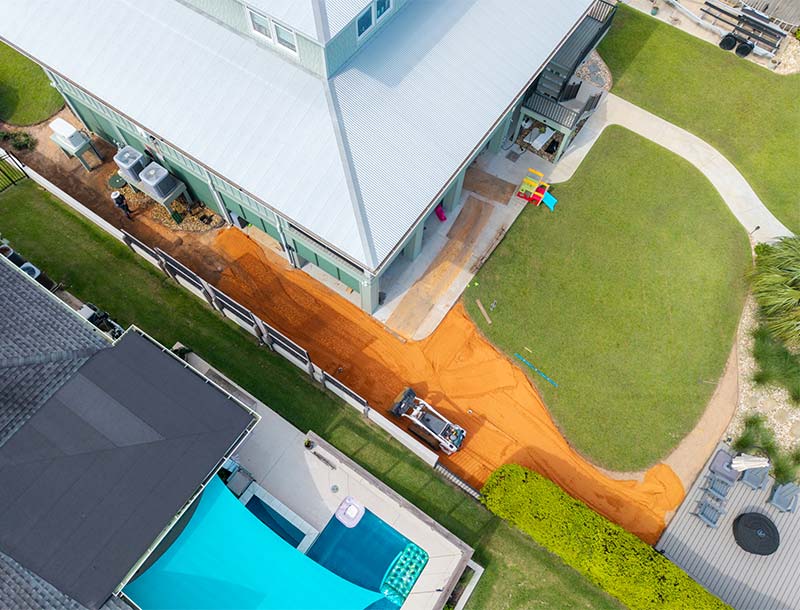
- Removing old grass and preparing the soil below.
- Installing a base made of compacted rock that lets water move through.
- Shaping that base so water knows where to go.
- Using turf with perforations so rain runs down into the base instead of sitting on top.
In a normal storm, water should move through, not linger.
If your yard has deeper drainage problems though, artificial grass alone won’t fix them. Sometimes we’ll recommend pairing turf with other solutions or addressing bigger grading and drainage issues first.
What It Costs And How Long It Lasts
There’s no sugar‑coating this. Artificial grass is a bigger upfront project than throwing a bit of seed around. The price depends on:
- How much area we’re covering and how complex the shape is.
- What we find when we remove the existing surface and how much base work is needed.
- Whether we’re doing standard lawn turf, pet turf, or golf turf.
- The details around edges, transitions, and access for equipment.
On the flip side, once it’s in, a well‑made and properly installed system can serve you for a decade or more with straightforward care.
Instead of paying in little bits every month for water, chemicals, and constant repair, you make one investment in a surface that is meant to stay consistent for years. We’ll walk you through that trade so you can decide if it lines up with your plans for the house.
How Deep South Landscaping Handles Design And Installation
What Happens During Your Site Visit
When we come out, it’s not a rushed “measure and run.”
We:
- Listen to what’s driving you crazy about your yard right now.
- Ask how you actually use the space: kids, pets, parties, quiet mornings with coffee.
- Note where water sits, where the sun hits hardest, and where grass is giving up.
- Talk about which sections make sense for turf and which might be better handled with plants, gravel, or other options.
The idea is to design something that works for your life and for this particular slice of the Gulf Coast, not just “sell square footage.”
What A Professional Turf Install Really Looks Like
A clean final surface starts with messy work.
Our crew will:
- Strip out existing grass or groundcover where turf is going.
- Prepare and compact a base that handles both use and water.
- Grade that base so it drains the right way.
- Lay the turf, trim it precisely, and secure the seams.
- Add infill to support the blades and fine‑tune the feel.
- Groom the surface so it looks and performs like it should.
We keep a close eye on edges, seams, and drainage points, because those are the things that separate a smooth installation from problems a year or two down the line.
Support After The Work Is Done
Putting turf in your yard is a long‑term choice, so we treat it that way.
You can expect:
- Clear information on the product and workmanship coverage for your project.
- Simple, written care guidelines you can actually follow.
- A local team you can reach if something doesn’t seem quite right later on.
We want the yard to keep working for you long after the install trucks pull away.
Ready To Talk About Your Yard?
If you’re tired of fighting muddy patches, stubborn brown spots, or a lawn that eats your weekends, you have options.
Artificial grass, done right for the Gulf Coast, can give you:
- A yard that looks pulled‑together all year.
- A putting green that lives right outside your back door.
- A pet area that your dogs love and your floors can live with.
The next step is simple. Let us come take a look, hear what’s going on, and show you what’s possible with artificial grass, pet turf, or a backyard green tailored to your property.
Your lawn doesn’t have to be a full‑time job. Let’s turn it into a place you actually enjoy.